
Quick facts
| Region | Sagarmatha National Park, Everest region |
| Our itinerary | 13 days |
| Highest point | Gokyo Ri, about 5,357 m |
| Highest sleep | Gokyo, about 4,790 m |
| Our rating | Challenging |
| Best seasons | Spring and autumn |
About the lakes
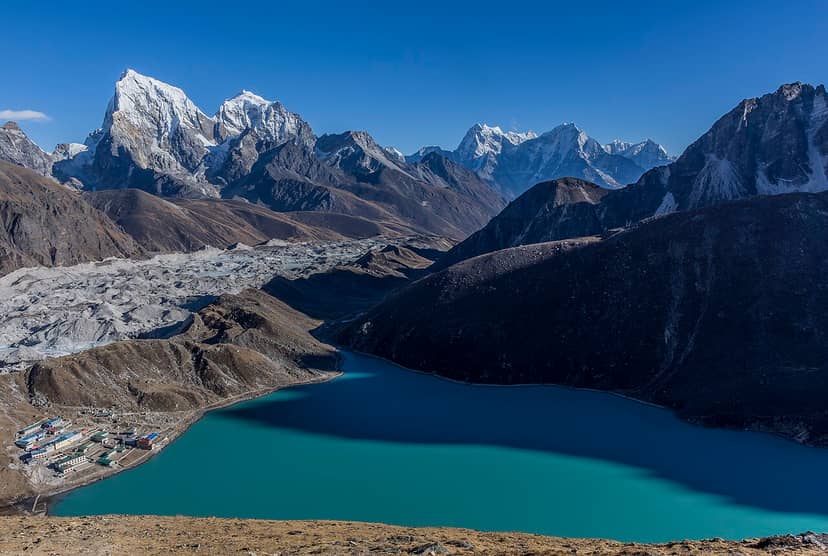
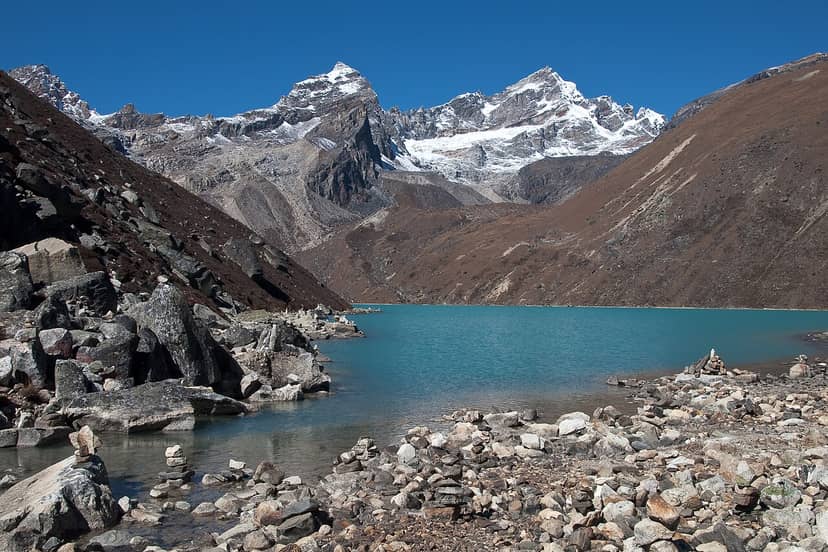
The Gokyo and associated lakes were designated a Ramsar wetland of international importance in September 2007, covering about 7,770 hectares. Sources usually describe six main lakes at about 4,700 to 5,000 m, although some count up to 19 when including smaller lakes. They're fed by meltwater and streams, and they sit beside the Ngozumpa Glacier, often described as the largest glacier in Nepal.
The main village sits next to Dudh Pokhari, the third lake. Please treat the lakes with respect, since they're sacred to many Hindus and Buddhists.
The route, day by day
| Day | Route | Sleep at |
|---|---|---|
| 1 | Arrive in Kathmandu | 1,400 m |
| 2 | Fly to Lukla, trek to Phakding | 2,610 m |
| 3 | Trek to Namche Bazaar | 3,440 m |
| 4 | Acclimatization day in Namche | 3,440 m |
| 5 | Trek to Dole | 4,040 m |
| 6 | Trek to Machhermo | 4,470 m |
| 7 | Trek to Gokyo | 4,790 m |
| 8 | Climb Gokyo Ri | 4,790 m |
| 9 | Descend to Dole | 4,040 m |
| 10 | Trek to Namche Bazaar | 3,440 m |
| 11 | Trek to Lukla | 2,860 m |
| 12 | Fly back to Kathmandu | 1,400 m |
| 13 | Departure | None |
Lukla flights are often delayed by weather, so plan spare days before your flight home.
Climbing Gokyo Ri
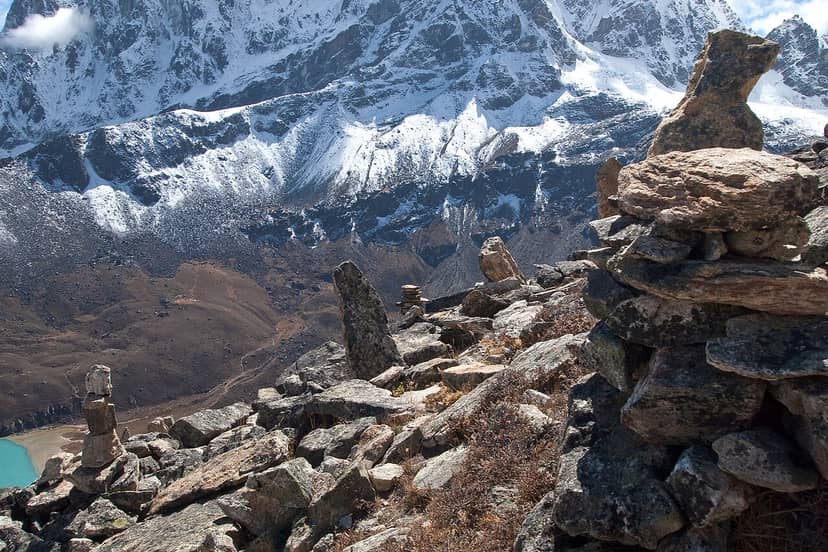
The climb from the village usually takes about 2 to 3 hours and is steep, but it isn't technical. Many people go early for clear air. On a good day, you'll see Everest, Lhotse, Makalu and Cho Oyu, as well as the great grey sweep of the Ngozumpa Glacier below. Take warm layers, water and plenty of time, because altitude slows everyone down.
What to expect on summit morning
Sources mostly give about 2 to 3 hours to climb from the village, and 1 to 2 hours to come back down. Your own time may be longer, and that's fine. Many people start before sunrise, but a later start can also work if it's clear and you've slept badly. Ask your guide which makes sense on the day.
- Carry water that won't freeze, such as in an insulated bottle kept inside your pack.
- Take a down jacket, gloves and a warm hat, because the summit can be very windy.
- Walk at a pace that lets you breathe easily, and rest often.
- Come back down straight away if you develop a bad headache, feel sick or become unsteady.
Our plan gives you a second night at Gokyo after the climb. This extra night gives you a little flexibility if the first morning is cloudy, or if you want to walk along the lakeshore instead. Treat it as a bonus and not a guarantee, as the weather here can change fast.
How hard is it?
It's a serious high-altitude trek, but there's no glacier crossing on the standard out-and-back route. The main challenge is the height gain from Dole to Machhermo and Gokyo. Sleeping heights rise quite quickly, so it's important to go slowly and report any symptoms. Read our altitude sickness guide.
Gokyo or Everest Base Camp?
| Gokyo Lakes | Everest Base Camp | |
|---|---|---|
| Main view | Gokyo Ri, with Everest in the distance and the lakes below | Kala Patthar, with Everest closer up |
| Crowds | Usually fewer | Usually busier |
| Our itinerary | 13 days | 15 days |
| Highest point | About 5,357 m | About 5,545 m |
| Bragging rights | Lesser-known | You stood at Everest Base Camp |
If you can't decide, the Gokyo and Everest Base Camp route via Cho La links both, but it crosses a glaciated pass and requires more experience.
Permits and costs
You'll need the same local charges as other Everest treks: the Sagarmatha National Park permit and the Khumbu municipality fee. See our permit guide. Lukla flights are often the largest cost, and our Everest cost guide covers most of the same items.
When to go
- Autumn: usually the clearest views, and the lakes are especially vivid.
- Spring: warmer days and good conditions, with some haze later on.
- Winter: very cold, and lakes may freeze. Some lodges close.
- Monsoon: rain, cloud and frequent flight delays.
Lodges and food
Gokyo has a good choice of lodges for its height, some with lake views. Rooms are simple and cold at night, and prices rise as you climb. Bring a warm sleeping bag.
Common questions
Can you see Everest from Gokyo?
Yes, from Gokyo Ri on a clear day. Everest looks smaller than from Kala Patthar, but the whole panorama is huge.
Can I go further up the valley?
Yes. If you have the time and energy, an extra day lets you walk on to the fourth and fifth lakes. Ask your guide.
Is it safe to walk on the glacier?
Only follow marked routes with your guide. The Ngozumpa moraine shifts and can be unstable.
Do I need a guide?
See our guide to the current rules, which conflict for the Everest region.
Next steps
See the day-by-day Gokyo Lakes Trek, read whether Everest Base Camp is worth it for you, or ask us about dates.


Comments